Friday, February 26, 2016

An Interview with Taliea Strohmeyer: "Color Guam"

TGalleria Explore, Learn, and Color Guam Launch.
Taliea Strohmeyer, a local artist trained in graphic design and painting, shared her story on how she fell in love with art and took us through her journey in how she started her business involving one of her greatest passions.

Please tell us about yourself and your family.
I’ve been an artist for over 30 years. Art is who I am, from the day I picked up a paintbrush I knew my calling. I was exposed to the medium at a very young age and count the late Sister Kathleen Sarmiento as a driving influence along with my musical family.

I learned a great deal of discipline and relentless practice in art school. This allowed me the opportunity to train in Europe & Asia.

Being a fine artist & graphic designer is a unique combination of skills. I had to merge both these skills when we created our first interactive historical book, “Explore, Learn & Color Guam” and reproduce my original works of art. Both these products are now sold online at our website and at various retail locations on Guam —Two Lovers Point, the GUMA Gallery, NEX and other retail outlets on island.

I also love teaching painting. I love to see how people go from “I don’t know” to “Now I know” when they complete a session. I have instilled a love of art in my children and count them along with my business partner and husband, Tom as my core inspiration today.

Why did you decide to start your own business?
I had spent over 20 years working in the field of advertising creating print campaigns, booklets, logos, packaging, basically any type of visual art that would communicate to the masses.  I had climbed the corporate ladder and found myself as a Creative Manager, managing several incredibly talented people, but I had always wanted to branch out on my own doing something art related and spend more time with my children.

GUMA Gallery in Hagatna.
In early 2014, I embarked on that journey. I picked up the phone and made an appointment with Denise Mendiola. We went over an entire list I had in mind. She said, “Go out there and see what’s in the market and then we could talk again.” I did the research and became frustrated – all my ideas were already on the shelves.  I felt discouraged but met with her again. She told me to think of something that hadn’t been made yet and said, “You have a talent, use it, spend some time thinking about it, and do more research.”

A couple of weeks went by and out of curiosity I went to my first FestPac meeting conducted by Monica Guzman. I was asked to introduce myself and what group I was from. I found myself surrounded by Guam’s cultural gatekeepers. It was a very profound moment for me because they were all in one room and had so much knowledge on our culture and our people and they were determined to educate our youth. Sitting there I felt a bit ashamed because I was raised on this island, I am Chamorro and what have I done to educate our people about our past, our culture & traditions in my art?  I also thought about my children and the type of legacy I want to leave behind. That day I made a promise to myself that whatever my product would be, it would educate our children and those who know very little about Guam and our cultural heritage.

As the weeks passed, I struggled to come up with a product with a historical focus. Until one day my husband and I decided to take our kids to the Plaza de EspaƱa. Being curious little kids they took off running. When they finally caught their breath we took them on a tour. They just loved the park and had so many questions. My daughter took a certain admiration with Chocolate House. She was only five years old at the time, but wanted to know who built it and why. She loved listening to the story. That was when a light went off on my head and the possibility of creating a historical book for kids and adults. That’s how “Explore, Learn & Color Guam” was born.


GUMA survey at TGalleria, Tumon.
What experience do you have in this type of business?

The only thing I had under my belt was my graphic and fine arts experience, managing employees and working with people, but the whole business aspect was something I had to learn.

How did the Small Business Development Center and other resources help you?
The guidance I received from my advisor, Denise Mendiola was truly one of the keys in creating our first product. I became organized, I did my homework, and I listened to her ideas and her professional advice and took the necessary steps I needed to make our idea into a reality.
What was the start-up process like? How did you fund your business?
The start-up process was challenging. It took a year for us to complete the coloring book. We kept an eye on our financial resources, what we had already spent on the book and art prints and what we were going to spend in the future. We looked at all the equipment that was needed, the amount of time it would take and had to compare costs and quality of each vendor.
We decided to use some of our funds in our savings to print the English/Chamorro version of the coloring book. Our Japanese/Chamorro book was funded by the Guam Unique Art & Merchandise (GUMA) grant money we were awarded. We were working with both the Guam Unique Art & Merchandise and SBDC to create our business plan.
Visiting family at TGalleria coloring Guam. 
What were some of the biggest challenges/experienced you experienced in the start-up process?
The market research, the financials and the marketing aspect of promoting our products. We had to present to the Board of Directors of GUMA. I can say looking back, we definitely had the jitters, but that nervousness wore off as we plunged into all the research and planning in our business plan. It was exciting and at the same time very emotional for me because of the enormous time and energy we spent on our business plan.
What is your most memorable triumph in your start-up process?
Handing our first printed book in English & Chamorro to our advisor, Denise Mendiola, completing our business plan and being awarded the Guam Unique Art & Merchandise (GUMA) grant a month after our presentation to translate out book in Japanese.
What are your short-term and long-term plans for your business?
Our short term plan is to build exposure with our products going into FestPac. Our long-term plan is be sustainable and to diversify our product line. We are currently working with Guam tour agents to purchase our books as they not only educate visitors, but could be used as a tour guide to get around Guam and it would be wonderful for visiting families to color together. We are also working with the public and private schools to carry our books and are adding more downloadable educational art on Guam on our website. We have another business idea brewing that we are very excited about, but that will all come in due time and we will definitely work with SBDC again.
What advice would you give to others who want to start a business at this time?
Find something you are passionate about. That passion and burning desire is one of the biggest keys. Learn from the experts, find an advisor at the SBDC who will help you through the process. Finish your business plan, it’s your roadmap. I read a lot of material on how some of the most successful businesses have started and the struggles these owners had to endure and the lessons they had to learn. Whatever you do keep moving forward.
For more information on how the Guam SBDC can assist you, visit our website at www.pacificsbdc.com and “Request for Counseling” to receive free, confidential, one-on-one business advisement.


Friday, August 28, 2015

Shenanigans Restaurant Saipan: Five Years and Growing

By: The CNMI SBDC Staff

Growing up in a restaurant environment, the exposure to the hotel and restaurant industry from her grandparents and father, and then later studied the business aspects of the industry in college, Belen Busby was destined to open a restaurant of her own. She stated, “It’s kind of a childhood dream that needed to happen.” Belen was born into the industry where her grandparents owned a restaurant in the Philippines and then having worked in F&B businesses since the age of 18. She went to college and earned a degree in Hotel and Restaurant Administration and a Bachelor’s of Science in Information Technology and Network Engineering. Belen has resided on Saipan for 21 years with her husband Michael Busby and son, Rafael.
Five years ago, Belen and Michael opened Shenanigans Restaurant located in Orchid St. Beach Road, Garapan serving up pasta, sandwiches, and other delicious entrees. The business was funded through their personal savings and personal loans. Belen recalls back on the obstacles they faced during their start-up years that not only affected the CNMI throughout but their business as well. Shenanigans Restaurant was opened during a period when the government and private sector were cutting hours, during the unfortunate and unforeseen disasters in Japan (one of the CNMI’s main tourism markets), and the increase in prices and utility rates. Other challenges have been obtaining CNMI-only Transitional Worker (CW) permits for workers, finding experienced U.S. Citizens to replace CWs, and maintaining operating capital to meet the shortcoming of the low season. However, the Busby’s survived and Belen stated that if they could survive those years, especially in an industry as tough as the restaurant business, she believes they can survive another five years and more.
As their five year mark approached, their equipment reached its mark as well. With the guidance and assistance of the CNMI SBDC, the Commonwealth Development Authority (CDA), and City Trust Bank, the Busby’s were able to obtain funding to purchase new equipment and repair their old ones. In addition, they were able to access additional operating capital and gained the knowledge of creating a formal financial portfolio for their company. One of the most difficult years for the Busby’s and Shenanigans Restaurant was the hardships they faced in 2014 and making it through that served as their most memorable triumph. Belen shared her gratitude and appreciation of the patronage of their customers and the support of their vendors and the trust that they have instilled in them over the years.


With her experience Belen advises entrepreneurs, “Follow your instinct and keep praying for guidance. Know who to trust and stay away from the ones that project negative vibes.” She continues on to say that a business is a gamble. You will never know if you are going to succeed unless you try. It is also a test of self-control and knowing when to stop. Before Belen and Michael opened Shenanigans, she shared her possible venture with others. They questioned her decision with the condition of the economy. However, she responded that [the economy] is in the bottom and that there is nowhere for it to go but up. She also stated that if she did not do it now then she might not have the chance to do it again and she will never know if it failed or succeeded.
Shenanigans Restaurant is located in Garapan, Saipan. They are open for breakfast at 7:30am on Saturday and Sunday only and every day for lunch from 10:30am – 3:00pm and dinner from 5:30pm – 10:00pm. Contact Shenanigans Restaurant at 670-233-8324 or e-mail shenanigans@islandviewers.com.
For more information on how the CNMI SBDC can assist you start or expand your business, contact their office at 670-664-3018 or visit www.pacificsbdc.com. 

Friday, August 21, 2015

Sari Sari Outlet Open at the Agana Shopping Center

By: Fred Granillo
Business Advisor
(Guam SBDC)

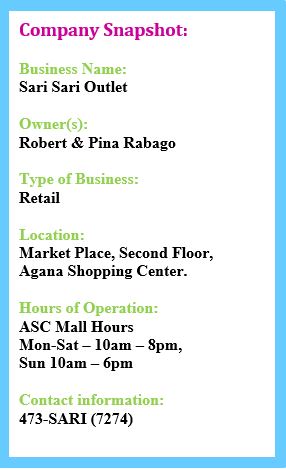
Robert & Filipina “Pina” Rabago are the husband and wife team that own Sari Sari Outlet.  Sari Sari in Tagalog basically means everything, but right now they’ve been focusing on cell phone covers and accessories.  Robert and Pina have been married for 10 years with two children (girl and boy) ages 9 and 7, respectively.  Robert is from Guam and Pina is from the Philippines.
Their business is truly a family run operation with Pina and Robert handling the day to day operations after work hours while their oldest daughter, Hazel Aulerio, runs the morning shift.  Even the children are there to help out after school – cleaning up, and putting the products in the packages.  Pina and Robert still have a full time job and consider this venture as their part time job after work and on the weekends.
Pina is the driving force behind Sari Sari Outlet. She had been planning and dreaming that one day she would own her own business. She had been working part-time at different retail positions and gained some knowledge on product placement, promotion and distribution.

 
Her last position was working part time for a small business at the Market Place in Agana Shopping Center that sold retail electronic accessories.  She liked and understood the various products and felt strongly that she could start up the same type of business but achieve a better market penetration and establish herself in this business. Having never owned a small business before, Pina had enough retail experience, customer service and product knowledge that she was convinced she could open her own business.  Robert was not so convinced that it could work.
Although Pina was confident that the business could work because of her knowledge of the other shop at that time, they realized further assistance was needed in developing their financial projections for the business. Robert knew Fred Granillo, Business Advisor and asked for assistance in developing their projections. The Business Advisor helped in clarifying how to develop and determine their total startup costs, operating expenses and projected sales. Robert noted he wanted to see what the numbers looked like but after working with the Small Business Development certainly opened his eyes to the real potential for his business financial operations.
Pina was now more focused on establishing the business and she never looked back.  She worked with her husband and had many discussions on planning, opening the business and committing to the daily operations. This business would be a meaningful part of their livelihood so she was going to see it through and give it her full attention.
With a husband and wife team, the stress level was at an all-time high during the initial set up of the business.  But the start-up process was very interesting and a real business education. For instance, the areas that they encountered were working with the suppliers to bring in the product and build their inventory, understanding the shipping process and costing, establishing the leasehold location including the leasehold improvements, and the business license process. Other items they had to learn were the setup of the credit card to enhance their sales and the recordkeeping function that they would handle on their own.
The business was started with their personal funds and a personal loan that they took advantage of to pay off another current loan and the difference used to start the business. They are conservative people so they wanted to limit the amount of debt used in the business that in turn to have a low monthly payment. Some of the biggest challenges were understanding the ordering part process as there are many product items offered by the supplier and each with a particular code. Any error in the coding process could produce the wrong product received. Further, trying to build up their inventory in a short time so they can have a sufficient opportunity to capture sales during the holiday season.  Pina was and is the only one with the retail eye for items that customers will want to purchase in the shop.
Owners of Sari Sari Outlet,
Pina and Robert Rabago
Their opening day and having to experience the first customer sale was the ultimate experience in establishing the business. That feeling was the best confirmation of all their efforts had come to fruition. Plus Pina noted there is a sense of freedom of operating your own business and she is happy that she took the step.
Pina and Robert’s short term plan is to refine the product mix within the store to identify the products most in demand form their target market. Further, they desire to enhance their marketing budget and increase an advertising strategy to attract more customers. So sales is the key focus. In the long term they want to eventually expand in to a second location so as to leverage their knowledge from the first store and further increase sales and potentially net profits. They want this business to be a long term sustainable business.
Pina and Robert’s advice for other small business startups is once you commit don’t look back.  Stay positive and get started on that business license.  Everyone will give you advice, but it’s really on you to make it happen.  Plus take advantage of free resources like the Small Business Development office that offers sound business advice to make sure you’re on the right track.


Friday, July 10, 2015

Killy's Store: Offering Refreshing Iced Products

By: Ketsen Haregaichig
Service Center Director/Business Advisor
Chuuk SBDC


Killy Fritz is a mother of four little girls and a part time custodian at Chuuk SBDC for over ten (10) years now.   My four little girls are attending private school and my salary barely meets their tuitions, school expenses and home needs.  Life is difficult but I want the best for me and my girls.

So, Killy decided to open up a business selling iced drinks. Killy went to the Chuuk SBDC to get help on business planning and start-up assistance. Killy stated, “I want to thank the staff of Chuuk SBDC for their help, strong support and encouragement that led me into developing my business plan and submitted to the FSM Development Bank.  After two visits to the bank I was informed that my loan request was approved.  I was very happy.”

The start up process was not easy but with the strong support and encouragement by the staff of Chuuk SBDC things went well. Killy sells three types of iced products on a dock where islanders come in the morning and leave in the afternoon. Her product is ideal for the heat. Killy sells ice blocks to fishermen and others who need ice for cold drinks and food preservation. She also sells ice cups which is a delicious and refreshing koolaid mixture. And lastly, she offers ice chofar which is a popular ice cup flavor in the Chuukese community. It is made of water mixed with carnation milk, condense milk, sugar, and chofar.

In the long run, Killy intends to purchase her own chiller where she will be able to produce more ice block and ice cups and be able to meet the demand of her present market.

Friday, July 3, 2015

Jiron in Keko's Taxi Service: An Interview with Owner Scott Paul

By: Anel Philimon
Service Center Director/Business Advisor
RMI SBDC


Please tell us about yourself and your family.
I grew up in a business environment in which my parents owned and operated a small retail store for which financed my brothers and I through school.

Why did you decide to start your own business?
Business and management is what I know and is basically my life.

What experience do you have in this type of business?
Retailing and Banking management.


How did the Small Business Development Center and other resources help you?
This program opened opportunities pertaining to capital availability and a business model to follow.

What was the start-up process like?
Start-up process had no issues. It was smooth with the guidance of the SBDC consultant and Bank of the Marshall Islands-BOMI representatives.

How did you fund your business?
Through the Bank of the Marshall Islands (BOMI)

What is your most memorable triumph in your start-up process?
Starting up the taxi service business.

What are your short-term and long-term plans for your business?
Short term goal is to pay off the loan in one and a half years and my long-term goal is to explore other business opportunities.

What advise would you give to others who want to start a business at this time?
Owning your own business will only be successful if you are true to it.

Friday, June 12, 2015

Blue Amber Trio Opens Guam Art Boutique at Chamorro Village

By: Denise Mendiola-Hertslet
Senior Business Advisor/WIB Program Coordinator
Guam SBDC


Growing up, Amber Wood and her mother, Char, often dreamed of opening a business together. Char always knew that “Blue Amber” would eventually be the business’s name. Wood’s entrepreneurial journey started in the third grade where she would walk door to door in her little 42-house town collecting recyclables. Wood even had her business card, “Kids who Care.” After that business, Wood and Char decided to open a phone-order pie company where people in her little town could order homemade apple pies made with apples from their own crab apple trees.

As Wood got older, she continued to come up with business ideas while traveling the world. She settled in Thailand where she met Songsri, whom she refers to as her Thai mother. They both shared the love and passion for art. Songsri was a painter, seamstress, crafter, and jewelry designer much like Wood herself. On a shopping trip, they came across beautiful stones and decided to create jewelry to raise funds for Wood to visit Char. Wood had been beading since she was eight and had created a jewelry business while in college. Once Songsri and Wood made enough money, Wood was able to go back to visit Char and share the revitalization of her business venture. Char was ecstatic. She had long loved gemstones and had been collecting for years. They planned a trip across the United States stopping at gift shops and showing their wares out of an old leather suitcase to potential buyers.


Wood continued her jewelry business and continued to traverse the globe. She found herself on Guam along with Char and her sister. This is where she decided to take her business to the next level. Creating the pieces, although time consuming, was the easier part of the start-up process because Wood already had the materials needed and Char invested $3,000 to fund licenses, display materials, tools, and other supplies. Wood set her eye on opening a small shop in Chamorro Village, but in order to secure a spot, her business plan had to be approved by the Guam Small Business Development Center (Guam SBDC). Before her first meeting with Senior Business Advisor Denise Mendiola-Hertslet, Wood drafted a business plan. Wood stated, “Denise was amazingly friendly, made the stepping stones of business development easy to understand and also helped me realize that I needed to tweak my margins if I wanted to make business sustainable.” Wood found that the process to start was time consuming yet straight forward regarding getting the proper paperwork and licenses. Extensive research in finding out vendor fairs, networking, and attending SBDC seminars and business counseling sessions were crucial components in finalizing her business plan from SBDC and gaining approval for the Guam Product Seal from the Guam Economic Development Authority (GEDA). Wood quoted, “The start-up process was an adventure, full of research and lots of legwork, but far worth it!”

Wood realized that collaboration with other artisans would be the perfect solution to such time consuming work; therefore, she organized a group of Made in Guam seal holders who had expressed interest in starting up a location together. In March, Wood opened Blue Amber Trio Guam Art Boutique at the Chamorro Village. While the boutique is currently under Blue Amber Trio, it is in many ways an unofficial co-op with the intention to become its own entity. Wood stated that she was filled with great appreciation that the vendor community embraced her with such love to create a system and space for a few of them to come together and grow together. It brings Wood great joy and pride when she sees someone wearing a piece of her jewelry and hear them say things like “This is my favorite pair of earrings” or when she sees repeat customers come back for their third or even fourth piece.

What does the future hold for Blue Amber Trio? Wood explains that in the short run, her plans are to find new and innovative ways to create unique and diverse product offerings that pull on the healing and metaphysical qualities of gemstones, in combination with items found locally on Guam, for not only jewelry but also other Made in Guam gift items. Wood intends to expand her offering to other retail locations throughout the island and not limit it to Guam Art Boutique, Underwater World, and Wednesday Night Market at Chamorro Village. In the long run, Wood plans to add two unique wholesale lines, one less expensive gift item lie for the ABC Stores and/or JP Superstores and a higher end silver line for DFS Galleria, in addition to other plans.

Wood leaves off with letting other entrepreneurs know to, “Go for it! Be on top of your books from the start and take each failure as a lesson with gratitude.” She ends with a quote from Rumi, “What you seek is seeking you.” Guam Art Boutique is open every day from 10:00am – 6:00pm except on Wednesdays and Sundays, they are open from 10:00am-9:00pm and 10:00am – 2:00pm respectively. To find out more information, please contact Amber Wood at 671-998-0560 or email blueambertrio@gmail.com or visit www.guamartboutique.com.

For more information on how the Guam Small Business Development Center can assist you, contact their office at 671-735-2590 or visit their website at www.pacificsbdc.com to register for small business workshops and/or request for FREE confidential one-to-one counseling. 


Tuesday, June 2, 2015

Advanced Eyecare, LLC: An Interview with Owner Peter Lombard MD

By: Denise Mendiola-Hertslet
Senior Business Advisor/WIB Coordinator
(Guam SBDC)


Freedom, Opportunity, and Service are the foundation blocks of Advanced Eyecare, LLC and the reasons why Peter Lombard MD decided to venture on his own to open up an ophthalmology clinic. We recently had the opportunity to speak with Peter on his journey in opening his business.

Please tell us about yourself and your family.

My mom and dad came to Guam in 1975 and built a house in Pago Bay where they still live.  I have an older sister in Hawaii and my brother Gabe lives with me on Guam. I came back to Guam in 2010 after spending a number of years off island for college, medical school, residency training, and military service.  I am leaving the U.S. Navy this summer to start my own ophthalmology clinic.

Why did you decide to start your own business?

Freedom, opportunity, service.  I have the opportunity to build something special and long-lasting, from the ground up.  My business will provide a service that is tremendously useful to our community, and that makes me very proud.  There’s something particularly liberating about being your own boss, and it’s empowering to know that the success and failure of your business rests only on your shoulders.

What experience do you have in this type of business?

I have no prior business experience running a private medical clinic, but I have the technical expertise to treat patients.  This is a problem many doctors face, and remains a big hurdle for many doctors when contemplating starting their own private practice.

How did the Small Business Development Center and other resources help you?

The hardest part for me initially was understanding the steps in the process.  Not having any prior business experience, even simple terms were hard for me to grasp at first.  I was assigned an advisor, Denise Mendiola, and she worked closely with me through each step.  She provided me with the Word and Excel templates I needed, and when I would get stuck on a certain section she helped me complete these parts.  She made sure I was moving forward at a steady pace, periodically asking how things were going and offering further assistance.  She has been an invaluable asset for me and I’m very grateful for her help!

What was the start-up process like?

After establishing the LLC, I determined what equipment costs I would have, the staffing I would need, and located a place to start my business.  I drafted a business plan and financial projections to submit with my loan application. Once approved for the loan, I acquired the medical equipment and clinic management systems needed to run a clinic, negotiated contracts with the local insurance carriers, hired and trained staff, and started to see patients. It all seems simple written out like this but this took about 6 months and was very stressful at times.
 
How did you fund your business?

I applied for a business loan, but also used significant personal savings for the startup costs.  Approximately 70% of startup costs were financed with the business loan, 30% from personal savings.

What were some of the biggest challenges you experienced in the start-up process?

I struggled a bit with the financial projections.  For my particular business it is hard to estimate the sales of the services I provide, because it is very different for each patient.  I’m not selling items at a fixed cost from inventory. 

What is your most memorable triumph in your start-up process?

Putting the LLC certificate up on the wall is always a nice feeling.  But I’ll never forget the day the network was hooked up and all the computers and software was working the way they are supposed to!  You live and die by your IT support!

What are your short-term and long-term plans for your business?

Short term: establish consistent patient base, grow the practice over the first 2 years and establish my clinic as a center of excellence in Guam. Long term: build a new eye clinic with room for significant growth and expansion.

What advice would you give to others who want to start a business at this time?

Definitely avail yourself of the services offered by SBDC.  Set reasonable time goals, and understand it’s a long process.  Put in the time and hours when required to get things off the ground when it’s crunch time.  Dream big.  Always look for more opportunities, and don’t be afraid to talk to people about your plans – you never know how they might be able to help you or what insight they can give.

For more information on how Guam SBDC can assist you, contact their office 671-735-2590 or visit www.pacificsbdc.com